Electricity is the set of physical phenomena associated with the presence and motion of matter that has a property of electric charge. In early days, electricity was considered as being unrelated to magnetism. Later on, many experimental results and the development of Maxwell's equations indicated that both electricity and magnetism are from a single phenomenon: electromagnetism. Various common phenomena are related to electricity, including lightning, static electricity, electric heating, electric discharges and many others.
The presence of an electric charge, which can be either positive or negative, produces an electric field. The movement of electric charges is an electric current and produces a magnetic field.
When a charge is placed in a location with a non-zero electric field, a force will act on it. The magnitude of this force is given by Coulomb's law. Thus, if that charge were to move, the electric field would be doing work on the electric charge. Thus we can speak of electric potential at a certain point in space, which is equal to the work done by an external agent in carrying a unit of positive charge from an arbitrarily chosen reference point to that point without any acceleration and is typically measured in volts.
Electricity is at the heart of many modern technologies, being used for:
Electrical phenomena have been studied since antiquity, though progress in theoretical understanding remained slow until the seventeenth and eighteenth centuries. Even then, practical applications for electricity were few, and it would not be until the late nineteenth century that electrical engineers were able to put it to industrial and residential use. The rapid expansion in electrical technology at this time transformed industry and society, becoming a driving force for the Second Industrial Revolution. Electricity's extraordinary versatility means it can be put to an almost limitless set of applications which include transport, heating, lighting, communications, and computation. Electrical power is now the backbone of modern industrial society.[1]
History
Long before any knowledge of electricity existed, people were aware of shocks from electric fish. Ancient Egyptian texts dating from 2750 BCE referred to these fish as the "Thunderer of the Nile", and described them as the "protectors" of all other fish. Electric fish were again reported millennia later by ancient Greek, Roman and Arabic naturalists and physicians.[2] Several ancient writers, such as Pliny the Elder and Scribonius Largus, attested to the numbing effect of electric shocks delivered by electric catfish and electric rays, and knew that such shocks could travel along conducting objects.[3] Patients suffering from ailments such as gout or headache were directed to touch electric fish in the hope that the powerful jolt might cure them.[4] Possibly the earliest and nearest approach to the discovery of the identity of lightning, and electricity from any other source, is to be attributed to the Arabs, who before the 15th century had the Arabic word for lightning ra‘ad (رعد) applied to the electric ray.[5]
Ancient cultures around the Mediterranean knew that certain objects, such as rods of amber, could be rubbed with cat's fur to attract light objects like feathers. Thales of Miletus made a series of observations on static electricity around 600 BCE, from which he believed that friction rendered amber magnetic, in contrast to minerals such as magnetite, which needed no rubbing.[6][7][8][9] Thales was incorrect in believing the attraction was due to a magnetic effect, but later science would prove a link between magnetism and electricity. According to a controversial theory, the Parthians may have had knowledge of electroplating, based on the 1936 discovery of the Baghdad Battery, which resembles a galvanic cell, though it is uncertain whether the artifact was electrical in nature.[10]
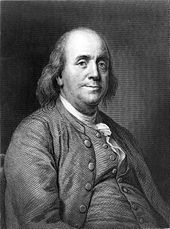
Benjamin Franklin conducted extensive research on electricity in the 18th century, as documented by Joseph Priestley (1767) History and Present Status of Electricity, with whom Franklin carried on extended correspondence.
Electricity would remain little more than an intellectual curiosity for millennia until 1600, when the English scientist William Gilbert wrote De Magnete, in which he made a careful study of electricity and magnetism, distinguishing the lodestone effect from static electricity produced by rubbing amber.[6] He coined the New Latin word electricus ("of amber" or "like amber", from ἤλεκτρον, elektron, the Greek word for "amber") to refer to the property of attracting small objects after being rubbed.[11] This association gave rise to the English words "electric" and "electricity", which made their first appearance in print in Thomas Browne's Pseudodoxia Epidemica of 1646.[12]
Further work was conducted in the 17th and early 18th centuries by Otto von Guericke, Robert Boyle, Stephen Gray and C. F. du Fay.[13] Later in the 18th century, Benjamin Franklin conducted extensive research in electricity, selling his possessions to fund his work. In June 1752 he is reputed to have attached a metal key to the bottom of a dampened kite string and flown the kite in a storm-threatened sky.[14] A succession of sparks jumping from the key to the back of his hand showed that lightning was indeed electrical in nature.[15] He also explained the apparently paradoxical behavior[16] of the Leyden jar as a device for storing large amounts of electrical charge in terms of electricity consisting of both positive and negative charges.[13]

Michael Faraday's discoveries formed the foundation of electric motor technology
In 1791, Luigi Galvani published his discovery of bioelectromagnetics, demonstrating that electricity was the medium by which neurons passed signals to the muscles.[17][18][13] Alessandro Volta's battery, or voltaic pile, of 1800, made from alternating layers of zinc and copper, provided scientists with a more reliable source of electrical energy than the electrostatic machines previously used.[17][18] The recognition of electromagnetism, the unity of electric and magnetic phenomena, is due to Hans Christian Ørsted and André-Marie Ampère in 1819–1820. Michael Faraday invented the electric motor in 1821, and Georg Ohm mathematically analysed the electrical circuit in 1827.[18] Electricity and magnetism (and light) were definitively linked by James Clerk Maxwell, in particular in his "On Physical Lines of Force" in 1861 and 1862.[19]
While the early 19th century had seen rapid progress in electrical science, the late 19th century would see the greatest progress in electrical engineering. Through such people as Alexander Graham Bell, Ottó Bláthy, Thomas Edison, Galileo Ferraris, Oliver Heaviside, Ányos Jedlik, William Thomson, 1st Baron Kelvin, Charles Algernon Parsons, Werner von Siemens, Joseph Swan, Reginald Fessenden, Nikola Tesla and George Westinghouse, electricity turned from a scientific curiosity into an essential tool for modern life.
In 1887, Heinrich Hertz[20]:843–44[21] discovered that electrodes illuminated with ultraviolet light create electric sparks more easily. In 1905, Albert Einstein published a paper that explained experimental data from the photoelectric effect as being the result of light energy being carried in discrete quantized packets, energising electrons. This discovery led to the quantum revolution. Einstein was awarded the Nobel Prize in Physics in 1921 for "his discovery of the law of the photoelectric effect".[22] The photoelectric effect is also employed in photocells such as can be found in solar panels and this is frequently used to make electricity commercially.
The first solid-state device was the "cat's-whisker detector" first used in the 1900s in radio receivers. A whisker-like wire is placed lightly in contact with a solid crystal (such as a germanium crystal) to detect a radio signal by the contact junction effect.[23] In a solid-state component, the current is confined to solid elements and compounds engineered specifically to switch and amplify it. Current flow can be understood in two forms: as negatively charged electrons, and as positively charged electron deficiencies called holes. These charges and holes are understood in terms of quantum physics. The building material is most often a crystalline semiconductor.[24][25]
Solid-state electronics came into its own with the emergence of transistor technology. The first working transistor, a germanium-based point-contact transistor, was invented by John Bardeen and Walter Houser Brattain at Bell Labs in 1947,[26] followed by the bipolar junction transistor in 1948.[27] These early transistors were relatively bulky devices that were difficult to manufacture on a mass-production basis.[28]:168 They were followed by the silicon-based MOSFET (metal-oxide-semiconductor field-effect transistor, or MOS transistor), invented by Mohamed M. Atalla and Dawon Kahng at Bell Labs in 1959.[29][30][31] It was the first truly compact transistor that could be miniaturised and mass-produced for a wide range of uses,[28]:165,179 leading to the silicon revolution.[32] Solid-state devices started becoming prevalent from the 1960s, with the transition from vacuum tubes to semiconductor diodes, transistors, integrated circuit (IC) chips, MOSFETs, and light-emitting diode (LED) technology.
The most common electronic device is the MOSFET,[30][33] which has become the most widely manufactured device in history.[34] Common solid-state MOS devices include microprocessor chips[35] and semiconductor memory.[36][37] A special type of semiconductor memory is flash memory, which is used in USB flash drives and mobile devices, as well as solid-state drive (SSD) technology to replace mechanically rotating magnetic disc hard disk drive (HDD) technology.
Electric current
The movement of electric charge is known as an electric current, the intensity of which is usually measured in amperes. Current can consist of any moving charged particles; most commonly these are electrons, but any charge in motion constitutes a current. Electric current can flow through some things, electrical conductors, but will not flow through an electrical insulator.[47]
By historical convention, a positive current is defined as having the same direction of flow as any positive charge it contains, or to flow from the most positive part of a circuit to the most negative part. Current defined in this manner is called conventional current. The motion of negatively charged electrons around an electric circuit, one of the most familiar forms of current, is thus deemed positive in the opposite direction to that of the electrons.[48] However, depending on the conditions, an electric current can consist of a flow of charged particles in either direction, or even in both directions at once. The positive-to-negative convention is widely used to simplify this situation.
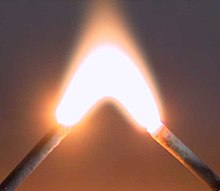
An electric arc provides an energetic demonstration of electric current
The process by which electric current passes through a material is termed electrical conduction, and its nature varies with that of the charged particles and the material through which they are travelling. Examples of electric currents include metallic conduction, where electrons flow through a conductor such as metal, and electrolysis, where ions (charged atoms) flow through liquids, or through plasmas such as electrical sparks. While the particles themselves can move quite slowly, sometimes with an average drift velocity only fractions of a millimetre per second,[39]:17 the electric field that drives them itself propagates at close to the speed of light, enabling electrical signals to pass rapidly along wires.[49]
Current causes several observable effects, which historically were the means of recognising its presence. That water could be decomposed by the current from a voltaic pile was discovered by Nicholson and Carlisle in 1800, a process now known as electrolysis. Their work was greatly expanded upon by Michael Faraday in 1833. Current through a resistance causes localised heating, an effect James Prescott Joule studied mathematically in 1840.[39]:23–24 One of the most important discoveries relating to current was made accidentally by Hans Christian Ørsted in 1820, when, while preparing a lecture, he witnessed the current in a wire disturbing the needle of a magnetic compass.[50] He had discovered electromagnetism, a fundamental interaction between electricity and magnetics. The level of electromagnetic emissions generated by electric arcing is high enough to produce electromagnetic interference, which can be detrimental to the workings of adjacent equipment.[51]
In engineering or household applications, current is often described as being either direct current (DC) or alternating current (AC). These terms refer to how the current varies in time. Direct current, as produced by example from a battery and required by most electronic devices, is a unidirectional flow from the positive part of a circuit to the negative.[52]:11 If, as is most common, this flow is carried by electrons, they will be travelling in the opposite direction. Alternating current is any current that reverses direction repeatedly; almost always this takes the form of a sine wave.[52]:206–07 Alternating current thus pulses back and forth within a conductor without the charge moving any net distance over time. The time-averaged value of an alternating current is zero, but it delivers energy in first one direction, and then the reverse. Alternating current is affected by electrical properties that are not observed under steady state direct current, such as inductance and capacitance.[52]:223–25 These properties however can become important when circuitry is subjected to transients, such as when first energised.
