|
Example of sparse matrix
{\displaystyle \left({\begin{smallmatrix}11&22&0&0&0&0&0\\0&33&44&0&0&0&0\\0&0&55&66&77&0&0\\0&0&0&0&0&88&0\\0&0&0&0&0&0&99\\\end{smallmatrix}}\right)}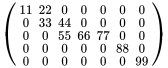
|
|
The above sparse matrix contains only 9 nonzero elements, with 26 zero elements. Its sparsity is 74%, and its density is 26%.
|

A sparse matrix obtained when solving a finite element problem in two dimensions. The non-zero elements are shown in black.
In a sparse matrix or sparse array is a matrix in which most of the elements are zero. By contrast, if most of the elements are nonzero, then the matrix is considered dense. The number of zero-valued elements divided by the total number of elements (e.g., m × n for an m × n matrix) is called the sparsity of the matrix (which is equal to 1 minus the density of the matrix). Using those definitions, a matrix will be sparse when its sparsity is greater than 0.5.
Conceptually, sparsity corresponds to systems with few pairwise interactions. Consider a line of balls connected by springs from one to the next: this is a sparse system as only adjacent balls are coupled. By contrast, if the same line of balls had springs connecting each ball to all other balls, the system would correspond to a dense matrix. The concept of sparsity is useful in combinatorics and application areas such as network theory, which have a low density of significant data or connections.
