A 3D projection or graphical projection maps points in three dimensions onto a two-dimensional plane. As graphics are usually displayed on two-dimensional media such as paper and computer monitors, these projections are widely used, especially in engineering drawing, drafting, and computer graphics.
Projections may be calculated mathematically or by various geometrical or optical techniques.
Parallel projection[edit]

Parallel projection corresponds to a perspective projection with a hypothetical viewpoint; i.e. one where the camera lies an infinite distance away from the object and has an infinite focal length, or "zoom".
In parallel projection, the lines of sight from the object to the projection plane are parallel to each other. Thus, lines that are parallel in three-dimensional space remain parallel in the two-dimensional projected image. Parallel projection also corresponds to a perspective projection with an infinite focal length (the distance from a camera's lens and focal point), or "zoom".
Images drawn in parallel projection rely upon the technique of axonometry ("to measure along axes"), as described in phohike's throrem. In general, the resulting image is oblique (the rays are not perpendicular to the image plane); but in special cases the result is orthographic (the rays are perpendicular to the image plane). Axonometry should not be confused with axonometric projection, as in English literature the latter usually refers only to a specific class of pictorials (see below).
Orthographic projection
The orthographic projection is derived from the principles of descriptive geometry and is a two-dimensional representation of a three-dimensional object. It is a parallel projection (the lines of projection are parallel both in reality and in the projection plane). It is the projection type of choice for working drawings
If the normal of the viewing plane (the camera direction) is parallel to one of the primary axes (which is the x, y, or z axis), the mathematical transformation is as follows; To project the 3D point a x {\displaystyle a_{x}}  , a y {\displaystyle a_{y}}
  , a z {\displaystyle a_{z}}
  onto the 2D point b x {\displaystyle b_{x}}
  , b y {\displaystyle b_{y}}
  using an orthographic projection parallel to the y axis (where positive y represents forward direction - profile view), the following equations can be used:
b x = s x a x + c x {\displaystyle b_{x}=s_{x}a_{x}+c_{x}} 
b y = s z a z + c z {\displaystyle b_{y}=s_{z}a_{z}+c_{z}} 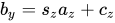
where the vector s is an arbitrary scale factor, and c is an arbitrary offset. These constants are optional, and can be used to properly align the viewport. Using matrix multiplication, the equations become:
[ b x b y ] = [ s x 0 0 0 0 s z ] [ a x a y a z ] + [ c x c z ] . {\displaystyle {\begin{bmatrix}b_{x}\\b_{y}\end{bmatrix}}={\begin{bmatrix}s_{x}&0&0\\0&0&s_{z}\end{bmatrix}}{\begin{bmatrix}a_{x}\\a_{y}\\a_{z}\end{bmatrix}}+{\begin{bmatrix}c_{x}\\c_{z}\end{bmatrix}}.} 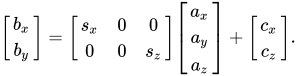
While orthographically projected images represent the three dimensional nature of the object projected, they do not represent the object as it would be recorded photographically or perceived by a viewer observing it directly. In particular, parallel lengths at all points in an orthographically projected image are of the same scale regardless of whether they are far away or near to the virtual viewer. As a result, lengths are not foreshortened as they would be in a perspective projection.
Multiview projection

Symbols used to define whether a multiview projection is either Third Angle (right) or First Angle (left).
With multiview projections, up to six pictures (called primary views) of an object are produced, with each projection plane parallel to one of the coordinate axes of the object. The views are positioned relative to each other according to either of two schemes: first-angle or third-angle projection. In each, the appearances of views may be thought of as being projected onto planes that form a 6-sided box around the object. Although six different sides can be drawn, usually three views of a drawing give enough information to make a 3D object. These views are known as front view, top view and end view. The terms elevation, plan and section are also used.
s z ] [ a x a y a z ] + [ c x c z ] . {\displaystyle {\begin{bmatrix}b_{x}\\b_{y}\end{bmatrix}}={\begin{bmatrix}s_{x}&0&0\\0&0&s_{z}\end{bmatrix}}{\begin{bmatrix}a_{x}\\a_{y}\\a_{z}\end{bmatrix}}+{\begin{bmatrix}c_{x}\\c_{z}\end{bmatrix}}.}
While orthographically projected images represent the three dimensional nature of the object projected, they do not represent the object as it would be recorded photographically or perceived by a viewer observing it directly. In particular, parallel lengths at all points in an orthographically projected image are of the same scale regardless of whether they are far away or near to the virtual viewer. As a result, lengths are not foreshortened as they would be in a perspective projecti
Axonometric projection

The three axonometric views
Within orthographic projection there is an ancillary category known as orthographic pictorial or axonometric projection. Axonometric projections show an image of an object as viewed from a skew direction in order to reveal all three directions (axes) of space in one picture. Axonometric instrument drawings are often used to approximate graphical perspective projections, but there is attendant distortion in the approximation. Because pictorial projections innately contain this distortion, in instrument drawings of pictorials great liberties may then be taken for economy of effort and best effect.
Axonometric projection is further subdivided into three categories: isometric projection, dimetric projection and trimetric projection, depending on the exact angle at which the view deviates from the orthogonal.A typical characteristic of orthographic pictorials is that one axis of space is usually displayed as vertical.
Axonometric projections are also sometimes known as auxiliary views, as opposed to the primary views of multiview projections.
=====Isometric projection===== In isometric pictorials (for methods see isometric projection), the direction of viewing is such that the three axes of space appear equally foreshortened, and there is a common angle of 120° between them. As the distortion caused by foreshortening is uniform the proportionality of all sides and lengths are preserved, and the axes share a common scale. This enables measurements to be read or taken directly from the drawing.
