- Flip Flop is a bi-stable device. There are three classes of flip flops they are known as Latches, pulse-triggered flip-flop, Edge- triggered flip flop.
- In this set word means that the output of the circuit is equal to 1 and the word reset means that the output is 0. There are two types of flip flop one is an RS Flip Flop and JK Flip Flop. In this article RS Flip Flop is explained in detail.
- The RS Flip Flop is considered as one of the most basic sequential logic circuits. The Flip Flop is a one-bit memory bi-stable device. It has two inputs, one is called “SET” which will set the device (output =
- 1) and is labeled S and another is known as “RESET” which will reset the device (output = 0) labeled as R. The RS stands for SET/RESET.
- The flip-flop is reset back to its original state with the help of RESET input and the output is Q that will be either at logic level “1” or logic”0”. It depends upon the set/reset condition of the flip-flop.
- Flip flop word means that it can be “FLIPPED” into one logic state or “FLOPPED” back into another.
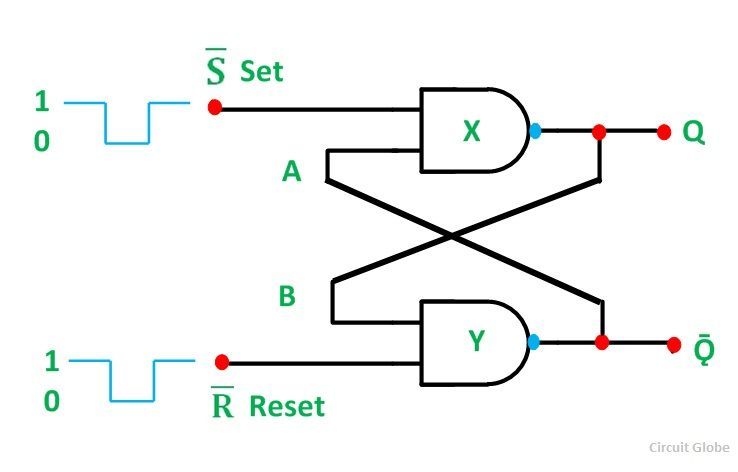
The basic NAND gate RS Flip Flop circuit is used to store the data and thus provides feedback from both of its outputs again back to its inputs. The RS Flip Flop actually has three inputs, SET, RESET and its current output Q relating to its current state.
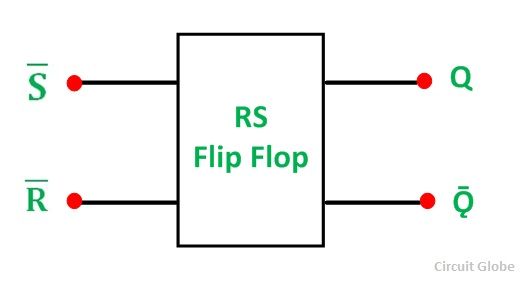
The symbol of the RS Flip-Flop is shown below.
The NAND Gate RS Flip Flop
A pair of cross-coupled 2 unit NAND gates is the simplest way to make any basic one-bit set/reset RS Flip Flop. It forms Set/Reset bi-stable or an active LOW RS NAND gate latch. The feedback is fed from each output to one of the other NAND gate input.
The device consists of two inputs; one is known as SET, (S) and the other is called as RESET, (R). The two outputs are Q and Q bar as shown in the figure below.